We need you to know about our Website Terms and our Privacy Policy. By accessing any part of the website you are indicating that you accept these. If you do not accept, please do not use the website.
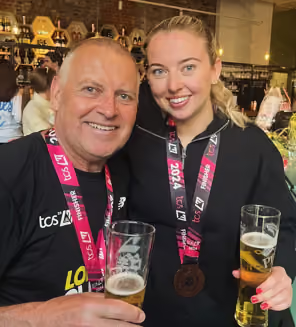
Sarah ran the 2024 London Marathon with her dad, Gary
Sarah was just 16 years old when she received the frightening news that she had a brain tumour.
Brain tumours can affect anyone
After experiencing frequent headaches, Sarah was sent for an MRI scan that revealed she had an epidermoid brain tumour.
Sarah’s doctors decided that since she was otherwise in good health and the tumour seemed stable, it was best to regularly monitor her instead of performing a high-risk surgery.
This all changed 10 years later
In 2023, Sarah started to experience more frequent headaches and tinnitus, and was told that the tumour had unexpectedly grown. She now needed two long, intense surgeries to remove as much of the tumour as possible.
“At the same time, I received my place for the 2024 London Marathon and I was determined to continue with my training. I went on to complete the milestone with my dad and running partner, Gary, and we raised an incredible £9,000 for Brain Research UK.”
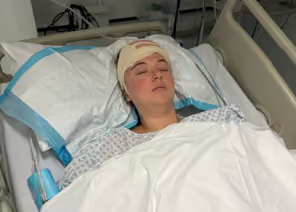
“Shortly after the marathon, I went on to have the first of two 9-hour surgeries, with the second surgery taking place the following year and resulting in a 9-day stay within the Intensive Care Unit of the hospital."
Now, Sarah is in recovery and has returned to work, as the doctors successfully removed 60-70% of the tumour, giving Sarah approximately another 10 years of life.
But there have been complications along the way. One side effect of the surgery is that Sarah has ongoing double vision due to the tumour’s proximity to her optic nerve. And, despite completing the marathon only a year ago, a 5km run is now a struggle for her.
Sarah, post-surgery
Research into brain tumours is desperately under-funded
Brain tumours kill more people under 40 than any other cancer, yet investment in brain tumour research has been far lower than for other cancers. As a result, there has not been the same progress in treatment and survival.
We have made brain tumours a research priority in order to improve the outlook for those affected. Since 2017, thanks to our incredible supporters, we have invested £4.6 million in vital research that is helping us to understand brain tumours, how they develop, and how we can better diagnose and treat them.
Neurosurgeon Harry Bulstrode received a Brain Research UK project grant in 2024 for his research, which aims to reprogramme immune cells to treat brain cancer. Immunotherapy treatments have revolutionised outcomes in some cancers but there has been less success in treating brain tumours. With our funding, Dr Bulstrode and team are taking forward research focused on a type of immune cell that is associated with resistance to immunotherapy, to try to overcome this barrier to treatment. You can read about his ground-breaking research here.
We rely on voluntary donations to fund this research
If you’re inspired by Sarah’s story, please consider making a donation to support our work, or look for ideas for other ways in which you could get involved in our work.
“I chose to support Brain Research UK because, although I know I will most likely always have a brain tumour, research can bring us a step closer to a cure for future generations.”
Find out more
Our website provides more information on the specific condition/s related to this story: